
 By Annie Cale
HomePod is Apple's smart speaker line. As of 2026, Apple sells two models: the full-size HomePod (2nd generation) and the compact HomePod mini. Both are built around Siri and Apple Music, support Lossless audio and Dolby Atmos Spatial Audio, and can be paired in stereo or grouped across rooms. If you already pay for Apple Music, HomePod is the easiest way to fill a room with it: just ask Siri, and the music starts.
The catch is that HomePod works fully only inside the Apple ecosystem. It has no Bluetooth audio input, and setup requires an iPhone or iPad on a recent iOS or iPadOS version signed in to the same Apple Account you use for Apple Music. This guide walks through the setup, the Siri commands worth knowing, and a way to keep your Apple Music songs playable even after your subscription ends.
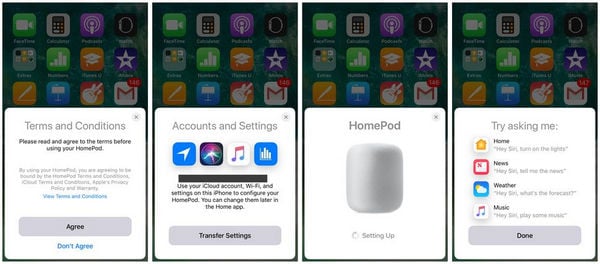
The key part to play Apple Music on Homepod is to do the settings. The following is a detailed guidance on completing the whole settings.
Step 1 Hold your iPhone near to your HomePod, and you will see a pop-up window from the bottom of your iPhone.
Step 2 Tap "Set Up" and choose the place you put your Homepod.
Step 3 Enable Personal Requests to authorize Siri in accessing required information.
Step 4 Tap "Agree" to the Terms and Conditions.
Step 5 Tap "Transfer Settings" on the Accounts and Settings window to use your iCloud account, Wi-fi, and Settings on your iPhone to configure your HomePod.
Step 6 Enter your Apple Account password to confirm your identity and sign in.
Next, just follow the instructions of Siri and then you will be able to play your Apple Music songs on your Homepod.
Ask Siri directly. Once set up, you don't need to open the Music app at all. Try: "Siri, play my Favorites playlist", "play Taylor Swift in the living room", "play something I'd like", "turn it up to 40 percent", or "what song is this?".
Turn on Lossless and Spatial Audio. Open the Home app, tap the Home icon, go to Home Settings > your name > Apple Music, and enable Lossless Audio and Dolby Atmos. Both HomePod models support Lossless up to 24-bit/48 kHz; Hi-Res Lossless is not supported on HomePod.
Hand off music from your iPhone. With a HomePod (2nd generation) or HomePod mini, bring your iPhone close to the top of the speaker and the song you're playing moves over instantly. Do it again to pull it back.
Pair two for stereo. Two HomePods of the same model in one room can be set as a stereo pair in the Home app, which makes a bigger difference for Apple Music than any single-speaker setting.
Play from a Mac. In the Music app on Mac, click the AirPlay icon and pick your HomePod to stream your library or any Apple Music track without touching your phone.
Apple likes locking users into its own ecosystem. There are always all kinds of limitations. The most annoying one is that we are confined to listen to Apple Music with its app and unable to enjoy them on other Media Players.
Besides, because of the encryption, we have to pay the subscription fee every month on Apple Music to keep listening to songs. Once we discontinue the service, we will lose all access to the songs on the platform. Is there any way that we can keep Apple Music forever or listen to them on, let's say, MP3 player? The following part will surprise you in a good way.
As we all know, all the songs on Apple Music are encoded, for which we are unable to save them as local files. To keep Apple Music forever, we'll have to get rid of this. Here we are going to show you a good way to get royalty-free Apple Music by converting Apple songs to a common format so that we can easily save them to our local computer.
NoteBurner iTunes Audio Converter is a professional DRM removal tool that can record Apple Music, Audiobooks as well as iTunes M4P Music and convert them to MP3/ AAC/ FLAC/ WAV/AIFF/ALAC format, preserving lossless quality.
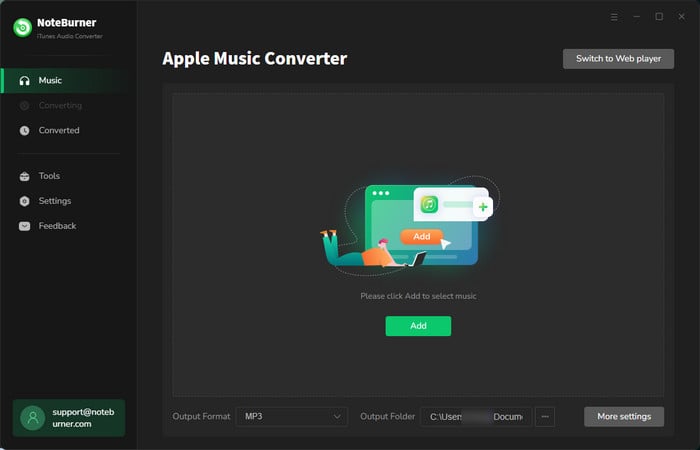
With three simple steps, you can easily download songs from Apple Music and enjoy them on any other media players as you like: 1) Choose "iTunes App" as the download source and click "Add" button on the upper right to upload your Apple Music to NoteBurner; 2) Click "Settings" button on the bottom left to choose output format (MP3/AAC/FLAC/WAV/AIFF/ALAC) and customize output path; 3) Click "Convert" button to convert your Apple Music to the output format you set in Step 2 and saved them to the designated output path. For more details, please refer to How to Keep Apple Music Forever.
Note: The free trial version of NoteBurner iTunes Audio Converter enables you to convert the first 1 minute of each song. You can buy the full version to unlock the limit.




